The Old Art of Keeping a Commonplace Book
A commonplace book turns gathered passages into a personal record of what holds your attention, helping you reflect on ideas without forcing quick conclusions.
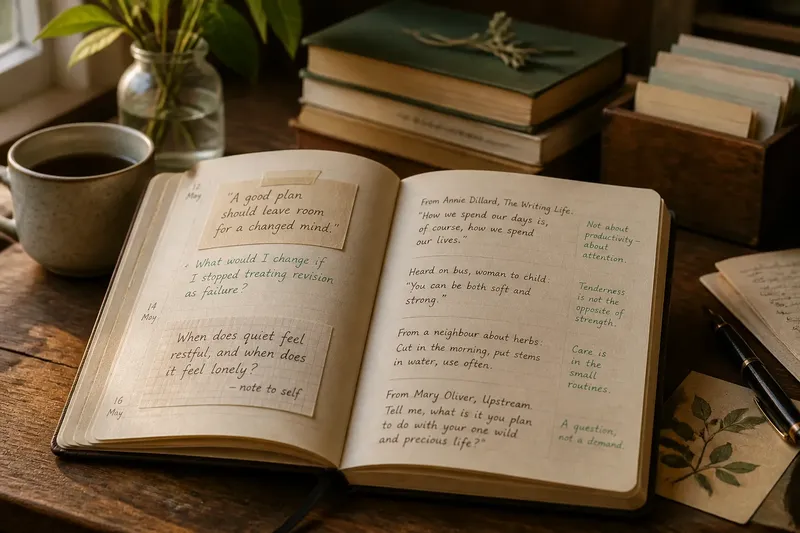
A commonplace book gives a thought somewhere to stay. You might copy a line from a novel, a recipe note from a friend, or a sentence overheard on the bus, then return to it when its meaning has had time to settle. The old art of keeping a commonplace book is less about collecting everything than choosing what deserves a place in your attention.
1. Begin with the difference between a diary and a commonplace book
A diary usually follows the days: what happened, how you felt, what you plan to do. A commonplace book follows ideas. Its pages gather passages, observations, questions and fragments that have caught your mind, often from very different parts of life.
That distinction frees the book from the pressure to be a complete record. You need not account for every day or explain every mood. A copied sentence can sit beside a note about a neighbour’s garden or a phrase from a conversation, provided each item has earned your interest.
In older forms, readers collected material under headings or in whatever order suited them. The point was to make useful thoughts available for rereading, not to preserve a perfect account of the source. Your own book can keep that spirit while remaining personal and informal.
Let the diary record what happened; let the commonplace book keep what stayed with you.
2. Choose what earns a place
A line does not need to sound profound to belong. Perhaps it names a feeling you had not managed to describe, puts a familiar problem in a fresh light, or makes you curious about a subject you usually pass by. The useful test is not “Will I agree with this for ever?” but “Do I want to think about this again?”
That question makes room for disagreement and uncertainty. You can keep a passage that irritates you, provided you note what unsettles you. You can also record a practical detail, such as a neighbour’s method for keeping herbs fresh, if it connects with a larger thought about care or attention.
Imagine you hear a friend say, “A good plan should leave room for a changed mind.” You write the sentence down and add, “What would I change if I stopped treating revision as failure?” The first entry is the gathered thought; the question makes clear why it is yours to keep.
Choose for resonance, not for the appearance of wisdom.
3. Record enough context to remember why
A quotation without its setting can become a puzzle later. Alongside a copied passage, note its source if you know it: a book’s title and author, the name of a speaker, or simply “heard at the bus stop”. If you are unsure, say so rather than filling in a guess.
Then add a brief note in your own words. It might say what you noticed, what you questioned, or what prompted you to copy the line. Keep the note close to the passage so that your future self can distinguish the original thought from your response.
This small act matters because memory edits. A sentence that felt like reassurance one day may later look like a challenge. A scrap of context helps you meet it again with less risk of assigning it a meaning it never had.
Write down the source and the reason for keeping it while both are still clear.
4. Arrange passages so they can speak to one another
Arrangement can be as revealing as selection. A book organised by subject makes it easy to find entries on, say, patience, work or belonging. A chronological notebook shows how your interests shift. Loose cards or a digital document let you move passages when a new connection appears.
There is no need to settle on a system before you begin. A simple contents page can point to entries; a few recurring headings can gather related thoughts; blank space can allow a subject to grow. If you use a digital notes app, tags may help, but too many categories can turn keeping the book into clerical work.
Say you have copied several passages about silence, but each came from a different context: a poem, a conversation and a note about walking without headphones. You place them near one another and add a question: “When does quiet feel restful, and when does it feel lonely?” The arrangement makes a connection visible without pretending to answer it.
Arrange for discovery, not for a flawless filing system.
5. Use the margins to keep your own voice present
Copied words can take up most of a page, especially when they are elegant. Yet the book becomes more reflective when your response has room too. A margin note, a short question or a careful objection can show how the passage meets your life without turning every entry into an essay.
Try small prompts: “This reminds me of…”, “I resist this because…”, or “What might this look like on an ordinary Tuesday?” They are invitations, not rules. Some passages will call for a longer reflection; others may need only a mark to show that you want to revisit them.
It can help to separate the copied words visually from your own. Use quotation marks, a different ink colour or a short source line. The distinction is especially useful when you later read quickly and want to know which thought began with you.
Give your response enough space to disagree with the passage.
6. Let returning to the book be a form of reflection
Rereading is where a collection can become more than a storehouse. A passage may look different after a move, a new responsibility or a quiet change in what matters to you. The words have not changed, but the reader has brought a different question to them.
You do not need a scheduled review to make this happen. Open the book when a page comes to mind, or read a small cluster when you are trying to name what feels important. Notice which passages still draw you, which have become less urgent and which now sit beside one another in a new way.
A useful mark is sometimes enough: a star beside a line that still feels alive, or a short date beside a changed response. Avoid treating old entries as promises you must keep. They are traces of attention at a particular moment, not contracts with your future self.
Read an old page as evidence of what once mattered, not as an order to remain unchanged.
7. Keep the practice small enough to remain welcoming
A commonplace book does not need a special leather cover, beautiful handwriting or a tidy index. A plain notebook, an envelope for slips of paper, or a notes app can all hold the practice. The best format is the one you can use without first preparing to be impressive.
There will be gaps. Some weeks may produce several entries; other stretches may produce none. A collection can remain valuable without being continuous, because its purpose is to preserve selected thoughts rather than prove that you have kept up a habit.
If you collect online passages, save enough source information to find them again and be mindful of copyright when sharing or publishing copied material. For a private book, a brief excerpt and your own comment are often more useful than a page of text without reflection.
Make the book easy to open, and allow it to be incomplete.
What do people ask about commonplace books?
What should I put in a commonplace book?
Keep passages, observations, questions and small practical details that you want to revisit. Add a short note about why each item caught your attention, even if the reason is simply curiosity.
Does a commonplace book need a theme?
No single theme is required. You can begin with a broad collection and notice recurring subjects later, or start with one interest and let it widen as your attention changes.
How is a commonplace book different from a journal?
A journal often follows your experiences over time, while a commonplace book gathers thoughts from many sources. They can overlap, but a commonplace book gives more space to selected material and your response to it.
Can I keep a commonplace book digitally?
Yes. A notes app or document can make entries searchable and easy to rearrange, while a paper notebook may feel more inviting for handwriting and margins. Choose the format that makes it easiest to return to what you have gathered.
The old art of keeping a commonplace book offers a modest way to notice what your mind returns to. Over time, the arrangement of passages may reveal not a fixed answer about who you are, but a record of questions and meanings you have been willing to keep close. When a new line catches you, give it a place and a note of your own; that is enough to begin.